Curators of old prints and manuscripts

Steven Van Impe and Marie-Charlotte Le Bailly

Old prints are books, newspapers and magazines made before the art of book printing was industrialised, which was around the 1800s. That is why every old print is unique, just like manuscripts. Each copy is separately designed, printed and bound and that is what makes them so special. Our two curators would love to help you in your research. 

Public engagement and venue rental

Leni Albertyn

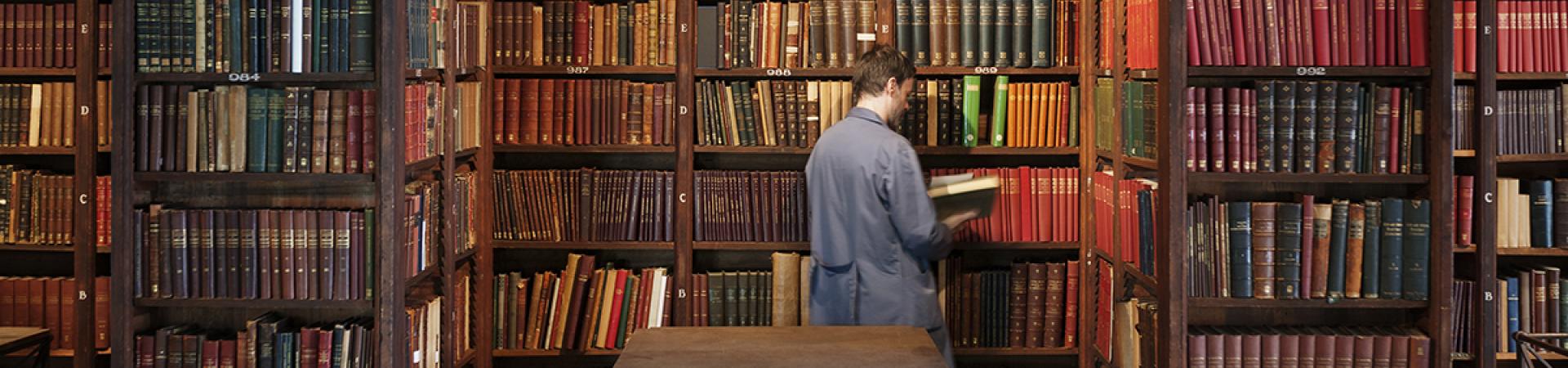
Who has never heard of our Nottebohm room? The impressive historical library is famous in all of Antwerp and beyond. That is partly thanks to Leni Albertyn. Besides the regular public engagement, she also manages the rental of this unique room. This can be for lectures, guest workshops and even television recordings from here and abroad. She makes sure everyone feels welcome.  

Educational coordinator

Thomas Martin

Our educational mission is all about information literacy. How do you adequately and critically work with the information that is available today? Thanks to our collection, a true treasure trove of information, we have a lot of experience on this subject ourselves, which we pass on to schools. We also focus on education online. Thomas Martin is our educational coordinator. 

Curator of modern prints

Marlou de Bont

From the 19th century onwards, the book becomes a mass-produced item, printed with the help of the industrial printing press on machine-made paper. This kind of mechanisation happens little by little. In our collection policy, we date the transition to the year 1830. From then on, we speak of ‘modern prints’. Curator Marlou de Bont manages this extensive part of our collection. Do you have research questions about the modern prints in our collection? Feel free to contact her. 

Restoration process

The restoration of the globes proceeded in different phases. Globes are complex objects made from various materials. Not only the paper of which the globes were made had to pass through a number of treatments, but also the mountings that support them required a specific approach.

Construction of a globe

A globe is constructed according to the rules of the art and does not merely consist of the sphere itself. Likewise the wooden axis construction and the mount are of paramount importance.

Treasures of the Nottebohm Room

For groups

Visit one of the most beautiful and prestigious library spaces with your association or group. A guide will take you through the history of the building and explain the special books kept there.

Globes in 3D

Through an online application, you now get the chance to watch the Blaeu-globes from the Nottebohm Room even closer. The digital tool allows to rotate the globes and to zoom in on the wonderful details.

Become a friend or make a donation

You can join our association of friends, the Endowment Fund for Books and Literature, or you can make a donation.

The Globes of Blaeu

The celestial and terrestrial globes of Willem Jansz. Blaeu (1571-1638) were in the 17th century praised as progressive creations in the field of cartographic techniques. The globes now at the Heritage Library were in 1836 gifted by Baron de Pret de Terveken to the City of Antwerp.