
Three years of innovation
Three years ago, PXL-MAD college from Hasselt launched the project Design for Digital Reading, a Blended Intensive Programme (BIP) within the Erasmus+ programme. The initiative arose from READSEARCH, led by prof. Bessemans and is guided by instructors Ann Bessemans, Kevin Bormans, Ewa Satalecka, Jan Piechota, Catarina da Silva and Ruben Dias. The programme encourages mobility and digital collaboration between students and instructors in Europe. Students from Hasselt work alongside students and lecturers from Warsaw (PJATK, Poland) and Barcelos (IPCA, Portugal). In practice, all participants collectively focus on one specific theme. The virtual exchange ensures that international collaboration begins before the trip and continues after, which increases the impact of the learning process.
Design for Digital Reading investigates the dynamic interaction between reading cultures and the evolving relationship between analogue and digital media. It is a three-year programme in which each new batch of students builds on the work of the previous one. Meanwhile, the same partners started a new follow-up programme, also with European funding. This creates a unique process: because students further develop the work of previous groups, a natural filtering of projects occurs whilst leaving room to experiment.
The first year focussed on the theory and inspiration sources from the Heritage Library. The second year primarily researched techniques and media connected to digital reading. The assignment for the third year was to translate these insights into concrete applications.
From collection to creation
The starting point for this international project is the collection of the Heritage Library. We read more today than ever before, but our reading habits have changed drastically, particularly over the past twenty years. Yet, we seldom think about how technology influences our literacy and concentration. The confrontation with the physical book is needed to understand how people have processed, read, shaped and structured information throughout centuries. Only when students see the physical books and their hierarchical reading structures, does the intellectual exercise become tangible.
Expo: prototypes alongside historical inspiration
The instructors selected four innovative projects from BIP with large future potential. These prototypes will be displayed alongside the historical works that served as inspiration.
Multi-sensory Fairytale
The result of this project is a tangible book in which the fairytale of Hansel and Gretel is revived with a combination of audio and tactile elements. It was specially designed to enable blind and visually impaired children to experience the story. Unique to this project is that it is a completed end product, of which the student team held the same composition throughout different editions.
The students found inspiration in tactile works, varying in historical techniques from volvelles (rotating discs made from paper or parchment) and unfolding pages to modern pop-up books and tactile elements from artist publications.
Interactive fairytales
This project explores how textual narratives can be intertwined within a digital environment. Different fairytales from the countries and cultures of the BIP-team served as the starting point. The result is a dynamic, fluctuating storyline in which characters, spaces and scenarios from well-known fairytales interact in an immersive VR-environment. Because of the interaction between text and image, a new narrative unfolds in each reading session, guided by the choices of the reader. The students were inspired by collection items in which text and image interact with each other. They started from both modern illustrated stories like comics and graphic novels as well as early modern works in which illustrations and text were combined.
Virtual Statement Closet
In the physical translation of this project – a mannequin with a T-Shirt full of AR (Augmented Reality) –prints and QR-codes – activism and social engagement regarding climate and nature are the focus. The garment functions as a tool for action because a digital layer is added that invites the user to learn more and get involved in climate action. In short: a digital and portable banner for the activist of the future.
The students were intrigued by book objects that were already ‘illegible’ in their physical form, like books behind glass or the Bottled poems of Marcel Van Maele, and on top of that are impossible to reproduce digitally. Inspired by both the digital keys as well as physical book objects, they decided to develop something that only functions in digital form. This led to a two-layered design: the tangible form of the garment and the hidden message behind a digital gateway. In this layering, there resides a clear connection between activistic or banned documents, in which messages are often protected or camouflaged.
Gesture reading
Although this project was only created in December 2025, it is not any less promising. Gesture reading is a research-oriented reading method in which hand gestures are converted into digital actions. This opens a world of possibilities to academic readers: sensors that register body movements allow us to manipulate, analyse and research texts in new ways. The method combines the familiar physique of reading with digital power: from navigating and summarising to the linking of themes and pop-up notes.
The inspiration resides in the visual characteristics and feeling of the classic book, enhanced with modern technology. The instructors see a connection with the complex structure of old prints, which are perfect for this new approach to research.
Discover more projects
The exhibition will also show a selection of other projects in a video.
- Secret code explores how letter designs, strengthened by programming, make prohibited communication possible. The inspiration for this project was taken from historical volvelles and cryptic writings in old prints.
- Luminara starts from the tradition of the illuminated capital or the ornamented initial. Letters that used to be decorated by hand receive a digital transformation in this project. The illuminated initials and historical picture books formed a fundamental source of inspiration.
- Poetry & emotions analyses how typography can be used to convey deeper meanings and complex emotions. Taking a feminist poem as their starting point, the students tried to translate the emotional load as accurately as possible into digital form. Through a combination of interactive digital actions and different languages, they challenge the reader to not only read but also feel the poetry.
- Noisy over-information investigates the impact of digital information-overload on our brain. The result is an installation in which the projected text distorts and reacts to the background noise in the room. The students were inspired by the overwhelming amount of information in the collection.
Response: heritage in dialogue with the future
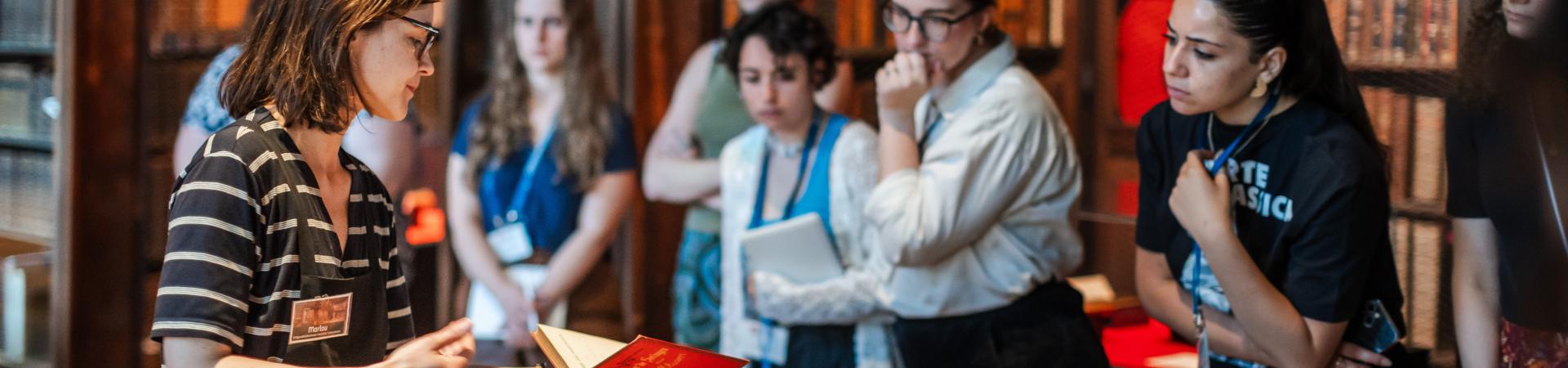
The Heritage Library, in turn, looked for collection items that respond to the theme or design of the student projects. These pieces are deliberately not placed behind glass but are discussed by a curator during interactive sessions with groups of college students. The dialogue that emerges emphasises not only the power of digital alternatives and new media, but also the intrinsic value of the heritage. It shows how relevant historical sources remain for education, research and innovation.
Instead of just placing letters on a screen, the students looked for subtle and daring typographical solutions that enrich our reading experience instead of dulling it. This exposition invites you to become the reader of tomorrow.
Want to visit the expo?
Free admission during:
- Open Monument Day on September 13, 2026
- Science Day on November 15, 2026
During regular guided tours the guide will also highlight the project.
For groups from higher education there is also the possibility to book a guided visit between September 13 and November 29, 2026.